Any athlete can be tested at any time, both In- and Out-of-Competition.
An athlete can be tested by a National Anti-Doping Organisation (NADO), a National Olympic Committee (NOC), a Regional Anti-Doping Organisation (RADO), an International Federation (IF) a Major Event Organiser (MEO) or the World Anti-Doping Agency (WADA). These organisations can delegate the testing to a third party, such as the ITA.
Sample Collection Personnel (SCP) conduct the testing. SCP include:
All SCP are trained to do their role and to guide athletes through each step of the process.
The ITA collect urine, blood serum, blood ABP (for an Athlete Biological Passport (ABP)) and Dried Blood Spot (DBS) samples.
Athlete rights during testing are:
Athlete responsibilities during testing are:
The Athletes’ Guide to testing (available in 13 languages) provides clear descriptions of each step of the sample collection process from athlete selection to Doping Control Form completion.
Once the sample collection process is complete, each sample is sent with a tracked chain of custody to a WADA accredited laboratory for analysis.
For more information on testing, athletes and support personnel are encouraged to explore this section of the ITA Athlete Hub. For additional support, please contact us.
18 November 2025

The FAQs are grouped into the following topics:
For more information, please see the testing section of our Athlete Hub or contact [email protected]
Any athlete under the jurisdiction of an anti-doping organisation and subject to their anti-doping rules can be tested at any time, both In- and Out-of-Competition.
Yes, however, there are modifications available to the process for minors (those under 18) and other protected persons.
The World Anti-Doping Agency (WADA) is responsible for the World Anti-Doping Code, which outlines the rules and procedures for testing (the Doping Control Process) which must be followed.
Yes. As any athlete can be tested, it is important that they understand their rights and responsibilities. We encourage regular education to ensure athletes and support personnel remain informed.
WADA publishes annual reports on sample collection statistics where the sport, amount, type of test and analysis are detailed. Reports can be viewed here.
The selection of athletes as well as the frequency, timing and type of the sample(s) collected, is dependent on many factors. Those factors may not apply to all athletes to the same extent which adds to the unpredictability of doping control.
The athlete should request an interpreter. If an interpreter is not available, the athlete must proceed with the test in accordance with known doping control processes, referring to online resources and body language where suitable. The athlete can comment on their Doping Control Form that no interpreter was available and follow up with their NADO or IF as soon as possible following the test, where relevant.
This would result in Anti-Doping Rule Violation 2.3 (Evading/Refusing) and (up to) a four-year ban.
No, an athlete cannot refuse to be tested if they are menstruating (have their period). For reassurance, Sample Collection Personnel are professionally trained and are equipped to handle various scenarios and situations with sensitivity and understanding. Athletes should share any concerns with Sample Collection Personnel so they can do what is possible to support athletes through the process.
Any suspicions of doping should be reported to an Anti-Doping Organisation (e.g., the ITA, a NADO, WADA). A test cannot be requested by an individual, but information about suspected doping can lead to an investigation from which testing may be an outcome.
Even if your support person does not want you to be tested you must always take the test. If an athlete refuses to be tested, this will result in Anti-Doping Rule Violation 2.3 (Evading/Refusing) and (up to) a four-year ban from sport.
If, as an athlete, you feel pressure from a support person to not fulfil your anti-doping responsibilities, you should speak to another trusted member of your support team and/or report to an Anti-Doping Organisation (e.g., the ITA, your NADO, WADA).
If a support person’s actions impact the testing of an athlete, this could be considered as Anti-Doping Rule Violation 2.5 Tampering or Attempted Tampering, which would result in a ban for the support person (up to four-years of ineligibility).
There is no maximum number of times per year an athlete can be tested. The frequency of testing depends on different factors such as testing pool inclusion, competition frequency, results, etc.
Testing can be a sensitive and uncomfortable experience for some athletes however it is necessary to protect clean sport. For reassurance, Sample Collection Personnel are professionally trained and are equipped to handle various scenarios and situations with sensitivity and understanding. Athletes should share any concerns with Sample Collection Personnel so they can do what is possible to support athletes through the process. However, religious or cultural sensitivities do not provide grounds to refuse a test.
In-Competition testing is sample collection that occurs within the In-Competition period which begins at 11:59pm the night before a competition until the end of that competition or associated doping control, whichever occurs last. WADA may approve an alternative definition if an International Federation (IF) can justify this is necessary in their sport. Athletes should always check their IF rules to understand the definition applicable to them.
Out-Of-Competition testing is sample collection that occurs at any time that is not In-Competition. Out-Of-Competition testing can occur anywhere however common locations include athlete accommodation when travelling, training venues and the locations of regular activities which athletes included in a testing pool need to provide in their Whereabouts information.
A Testing Authority is the organisation that authorises testing on athletes it has authority over, this can be a National Anti-Doping Organisation (NADO), an International Federation (IF), a Major Event Organiser (MEO) or WADA. A Testing Authority can delegate the testing to a third party, such as the ITA, but it remains responsible under the World Anti-Doping Code.
A Results Management Authority is the organisation who receives the results of a test, investigates potential rule violations and handles legal proceedings (as relevant).
A measurement of urine concentration which is checked as part of the doping control process to ensure the sample is suitable for analysis. If, for example, an athlete is over hydrated, their urine might be too diluted (specific gravity not met) for analysis to occur.
In-Competition testing can either be target testing and/or random testing. Random testing is when an athlete is selected for testing based on certain pre-decided criteria such as a competitive result, podium finish, and/or any other criteria that the ADO may determine, as opposed to a specific individual being targeted for testing.
When a specific individual has been targeted for doping control based on criteria set out in the International Standard for Testing (section 4.5.2 and 4.5.3). As sample collection is diligently planned as part of a risk assessment, most testing is target testing.
Maintaining unpredictability is important in anti-doping to maximise the detection and deterrence which is more likely when testing occurs with no-advance notice.
Yes. Athletes who are serving a ban from sport can, and should expect to, be tested anytime and anywhere. During a ban, the anti-doping rules continue to apply to an athlete including filing Whereabouts information if required to do so.
No. Testing is planned to maximise unpredictability and the deterrence and detection which is possible as a result. As such, testing may not occur at every competition however athletes should be prepared to be selected for testing at any time.
Selection is based on many factors which can result in an individual being tested more than other athletes when these factors apply to them. Examples of such factors may include (but are not limited to) the risk profile of a sport, previous test results, those competing at the highest level, or for prevention and deterrence. Athletes are also likely to be tested in preparation for Major Events as shown in the Paris 2024 pre-Games testing statistics.
Generally, athletes are tested between 5am and 11pm although in exceptional circumstances an athlete can be tested outside of this window.
Participating in a further competition the same day is a valid reason to request a delay to testing if a sample cannot be provided prior to an athlete competing in the other competition. However, during any delay, an athlete must continually be observed by a chaperone or other Sample Collection Personnel.
Once notified for doping control, athletes must complete the process regardless of other plans. If an athlete refuses to be tested, this will result in Anti-Doping Rule Violation 2.3 (Evading/Refusing) and (up to) a four-year ban from sport.
An athlete cannot refuse to provide a sample once notified for testing therefore they would need to stay to complete the process. If an athlete refuses to be tested, this can result in Anti-Doping Rule Violation 2.3 (Evading/Refusing) and (up to) a four-year ban from sport.
When planning logistics, it is important athletes and Athlete Support Personnel consider potential In-Competition testing when making travel arrangements.
It is a responsibility of the athlete and their team management to make plans that consider testing for one or more of their athletes. When doing so, this should consider transportation and other logistics, and an athlete representative during testing, who this is, and how they are included in planning.
The ITA collects urine, blood serum, blood ABP (for an Athlete Biological Passport (ABP)) and Dried Blood Spot (DBS) samples.
Yes. An athlete can be selected for more than one test type in a single testing session.
No. The athlete must provide the type of sample for which they have been notified, e.g. if they have been notified for a urine test, they must provide a urine sample. For reassurance, Sample Collection Personnel are professionally trained and are equipped to handle various scenarios and situations with sensitivity and understanding. Athletes should share any concerns with Sample Collection Personnel so they can do what is possible to support athletes through the process.
The A sample is used for the initial analysis and the B sample may be analysed at a later stage, if the Athlete or Testing Authority wish to have the A sample result reconfirmed. The B sample may also be stored for up to ten years for further analysis. The A sample may also be stored for up to ten years for further analysis if the full volume is not used in the initial analysis.
Providing a urine sample can take time for many athletes. This may be due to nerves, dehydration, unfamiliarity with the process and other reasons. Sample Collection Personnel are prepared for this and will give athletes the time they require to provide their sample. Sample Collection Personnel will also do what they can to support athletes through the process. It is recommended an athlete takes an Athlete Representative with them to the Doping Control Station; they will not watch them provide the sample but can help to ease nerves and provide additional reassurance throughout the process.
This is considered a ‘partial sample’ in which case the urine that has been collected will be sealed using a temporary seal. This will be stored securely by the DCO until the athlete provides additional sample(s). This will be documented on the Doping Control Form. These steps will be repeated until the required volume of urine has been collected. Once the required volume is met, the Athlete will have to open the partial sample and check its integrity and then combine the samples together so a full sample can be then sealed off and sent for analysis.
Once the maximum amount of urine for the collection vessel has been collected the athlete can empty their bladder or catheter into the toilet.
Blood will not interfere with the analysis of a urine sample, so this is not an issue from an anti-doping perspective.
Urine sample collection can continue as normal if an athlete is menstruating (has their period).
For reassurance, Sample Collection Personnel are professionally trained and are equipped to handle various scenarios and situations with sensitivity and understanding. Athletes should share any concerns with Sample Collection Personnel so they can do what is possible to support athletes through the process.
The Sample Collection Personnel watching the urine leaving the athlete’s body ensures that the sample being provided is indeed from the athlete being tested (i.e., it is not substituted) and ensures there is no tampering with the sample.
Providing a sample under direct observation of a Sample Collection Personnel is a mandatory part of the testing process.
If an athlete accidentally spills their sample, they will need to provide additional urine until the required volume has been secured in the A and B Bottles (at the correct specific gravity). However, spilling of a sample will be investigated and may be considered tampering (with the doping control process) which is a rule violation.
All DCOs in the ITA Testing Force have a background check. The ITA’s International Doping Control Officers (IDCO) course also covers safeguarding, including what it means, how to act and what to look out for. The ITA has a process for investigating any reports of unprofessional behaviour.
The urine sample must be witnessed in the same way for athletes using a catheter – the witness must observe the athlete insert the catheter and witness that the urine is coming from the same catheter. Athletes using a leg bag must also show the witness where the urine tub is inserted into the body.
In general, modifications can be made during Doping Control for athletes with a permanent or temporary impairment, including assistance with a catheter. For further details please see our Guide to Doping Control for Athletes with Impairments.
Important – Note that it is the athlete’s responsibility to provide any equipment needed to provide a urine sample.
The Sample Collection Person who witnesses the athlete pass a urine sample must be the same sport gender as the athlete. Other, non-witnessing, personnel can be of any gender.
A minimum of 60mL goes into the A Bottle and 30mL goes in the B Bottle.
The athlete should secure the seals on the samples, then the Doping Control Officer (DCO) will check the seals of Bottles before they are packaged for sending to the laboratory.
It is a requirement that blood is collected only when an athlete is at a ‘steady state ’. This means an athlete who has not just exercised needs to rest for 10 minutes prior to sample collection. An athlete who has just trained or competed will need to rest for up to one hour before their blood sample can be collected or 2 hours if the sample being collected is collected in the scope of the Athlete Biological Passport. This does not apply for urine or dried blood spot sample collection.
It is not a requirement for athletes to rest following blood collection however if they feel dizzy or faint, they may wish to do so. Athletes are encouraged not to do any heavy lifting with the arm the sample was drawn from for 30 minutes after blood collection.
No. Only a small amount of blood (less than two tablespoons or 20mL) is collected. This should not affect athletic performance.
Tell the Blood Collection Officer so they can put necessary supports in place. You may also like to make a comment on your Doping Control Form so that this information is included on your profile for future tests.
No. The athlete must provide the type of sample for which they have been notified. If they have been notified for a blood test, they must provide a blood sample. Athletes are encouraged to tell the Blood Collection Officer about their fears so that suitable support can be provided.
Dried Blood Spot (DBS) is a type of sample collection which occurs by attaching a device to an athlete’s fingertip, upper arm, thigh or abdomen where a small device pricks the skin to draw small spots of blood. The blood is absorbed into special materials where it dries and is sent to a WADA accredited laboratory for analysis.
There are several steps involved in testing which differ depending on the type of sample collected. For more information on the urine and blood (serum) testing processes, we encourage athletes to download our Athlete’s Guide to Testing in their preferred language: An athlete’s guide to testing – English – International Testing Agency or see: Anti-Doping Process | World Anti Doping Agency
For more information on Dried Blood Spot (DBS) testing, see https://youtu.be/hRqAckUyUco
Yes. This is why there are International Standards and comprehensive compliance requirements that must be met by all Anti-Doping Organisations and WADA accredited laboratories.
When an athlete who is a minor (under 18) is selected for testing, the process is similar to that for adult athletes, but specific modifications are made to ensure their safety and well-being.
The key modifications to the process can be found in this Guide to Doping Control for Minor Athletes.
Athletes with both permanent and temporary impairments may require modifications during doping control to ensure their needs are met and they can complete the process.
Examples of modifications to the process can be found in this Guide to Doping Control for Athletes with an Impairment.
Understanding these modifications is essential for Athlete Support Personnel, who can act as an athlete representative and play an important role in supporting, guiding and assisting athletes during testing. Practical guidance can be found in A Guide for Athlete Support Personnel – Doping Control for Athletes with Impairments.
Yes. It is an athlete’s right to have an Athlete Representative during the Doping Control Process. The Athlete Representative would not witness the athlete provide their urine sample (unless the athlete requests this). Additionally, if the athlete would like them to, their Athlete Representative can watch the Sample Collection Person who is directly witnessing the sample being provided.
The Athlete Representative is expected to support the athlete throughout the doping control process; this includes calming any nerves and tasks like double checking sample code numbers and the Doping Control Form. The Athlete Representative should follow the instructions of Sample Collection Personnel.
The athlete should request the assistance of an Athlete Representative to help them read and complete the form. Alternatively, the DCO can do this. Should this be the case, this must be noted in the comments section.
The Doping Control Station is a limited access area, with only Sample Collection Personnel, athletes and their Representatives permitted to enter. When you report to the Doping Control Station, there may be other athletes and their Representatives waiting to provide a sample in the waiting area.
If an athlete has any concerns about privacy, they are encouraged to speak to the Sample Collection Personnel.
Generally, it is ok for an athlete to use their phone, however videos, recordings and photos of the Doping Control Station, Sample Collection Personnel and any other persons must not be taken. Once in the processing room, the phone should not be used.
Athletes will need to include (and check the accuracy of) the following information:
– Contact information
– The competition competed in (if an In-Competition test);
– Any substances (medications and supplements) used in the past seven days and if a blood sample is collected, any blood transfusions received over the past three months;
– The sample codes
– If they have a current therapeutic use exemption (TUE) (not requested, but useful);
– Any concerns or comments.
We encourage athletes to carefully check all details on the Doping Control Form, ensuring the numbers on the form match the numbers on their samples and signing all required fields at the end of the process.
An athlete can request a shower however it will be at the discretion of the Doping Control Officer (DCO) to approve or decline this request which is only permitted for health and safety reasons (e.g. open water swimming with algae or skin conditions aggravated by exercise). If approved, the athlete should be aware they need to remain in direct sight of the Sample Collection Personnel at all times from notification to the completion of doping control – including in the shower, in this scenario.
The three phases that follow sample collection are temporary storage, shipment and delivery to a WADA accredited laboratory for analysis. The progress of a sample through these phases is tracked through a chain of custody procedure. Following analysis, results are shared with the Results Management Authority and are recorded in ADAMS.
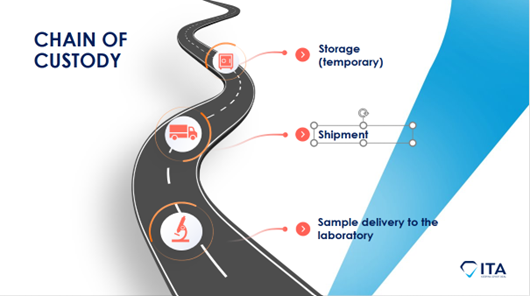
The sample collection process has several steps to mitigate or minimise the potential for tampering. This includes the requirement for a chain of custody procedure (who has the sample, when, where) and the need to use only WADA approved sample collection equipment including security kits with tamper evident seals which are checked upon arrival at the laboratory.
The Athlete should file comments on the Doping Control Form and ask to provide an additional sample.
Unique codes link the sample, documentation and athlete.
All WADA accredited laboratories are listed on the WADA website. This list is kept up to date to show laboratories with current accreditation meaning that, they can be used to analyse samples for anti-doping purposes.
There is an International Standard for the Protection of Privacy and Personal Information and an International Standard for Laboratories which stipulate how an athlete’s sample and private information must remain secure. WADA-accredited laboratories are unaware of the Athlete’s identity since they receive only the samples, documentation and Doping Control Forms referring only to the sample code number; the athlete’s name or other personal information are not made available to WADA-accredited laboratories. These International Standards must be adhered to for a laboratory to maintain its WADA accreditation.
There are three possible outcomes of sample analysis:
Samples can be stored for up to ten years so as new analysis methods are developed, doping substances are identified and additional information (and intelligence) about doping activities becomes available, samples can be re-analysed. Re-analysis applies to substances and methods that were prohibited at the time of sample collection (not at the time of re-analysis). Storage is for 10 years because this period is the statute of limitations for Anti-Doping Organisations to pursue Anti-Doping Rule Violations under the World Anti-Doping Code.
No. Only WADA accredited laboratories can analyse samples collected for anti-doping purposes.
The ABP is an electronic profile that tracks selected biological markers in an individual athlete’s blood and urine samples over multiple tests. Over time, the ABP can show the effects of doping rather than the presence of a prohibited substance in a sample.
A panel of experts will consider the ABP results and rule that:
Any substance that is included as a biological marker in an athlete’s biological passport will have the individual’s unique upper and lower levels established across several samples. With these levels established, any spikes or dips in the individual’s norms may be cause for further investigation.
If the sample is collected for the Athlete Biological Passport, additional information will need to be recorded either on a supplementary form or on an Athlete Biological Passport specific Doping Control Form.
Additional information to be collected includes:
There is no set timeframe for test results – it is determined by factors including the type of test (urine, blood serum or dried blood spot) and laboratory processing times.
Athletes can access their results in ADAMS (the Anti-Doping Administration System). If test results are positive, the athlete will be contacted directly.
Access to personal information is restricted to those who need visibility for anti-doping purposes only, including Anti-Doping Organisation staff planning tests, Sample Collection Personnel and TUE Committee members (as relevant).
Yes, athletes may eat and drink in the Doping Control Station however alcohol is not allowed.
Athletes should take their identification and a record of all substances (medications, supplements) they have used in the last seven (7) days. Athletes may also want to take warm clothing, food/drink and their phone (as relevant).
Possible reasons to request a delay in reporting to the Doping Control Station include (but are not limited to);
• A victory ceremony
• Finishing training or competing in further events
• Receiving medical treatment
• A media commitment
• Warming down
Any request for a delay requires approval from Sample Collection Personnel who the athlete needs to remain in direct sight of at all times.
Generally, sealed drinks will be available in the Doping Control Station. Athletes should keep this in their possession once opened and be cautious not to overhydrate (as this may dilute their sample – see ‘specific gravity’).
Sample Collection Personnel (SCP)are trained and accredited experts in one or more of the following roles:
Blood Collection Officer (BCO) – has received training and holds the necessary phlebotomy accreditation to collect blood samples.
Athletes can be tested anytime so it is important that they are prepared to be tested at home. An athlete cannot refuse to be tested, as this will result in Anti-Doping Rule Violation 2.3 (Evading/Refusing) and (up to) a four-year ban from sport.
Yes a minor can be tested Out-of-Competition. Two SCP are assigned to a testing mission involving a minor. While a minor can be tested at home (in the presence of an Adult Representative), it is preferred that the minor is tested at a location where the presence of an Athlete Representative (who is not a minor) is most likely to be available for the duration of the test, for example, at a training venue.
A DBS sample can be collected by any trained Sample Collection Personnel (unlike blood samples which may only be collected by a BCO who is holds a current phlebotomy certifications).


