Summer Youth Olympic Games Dakar 2026 may be your first international major event and your first exposure to anti-doping or you may be a regular on the international scene and have lots of anti-doping experience. Wherever your starting point is, we have put together this page to support you on your clean sport journey to Dakar and beyond.
As a youth athlete competing in Dakar, knowledge is power. If you know what you need to do and what to expect regarding anti-doping when you get to the Games, then you can focus on what you are there for: to perform at your best.

Engaging with clean sport education as an athlete will empower you to have control over your sport career.
Your National Olympic Committee (NOC) or National Anti-Doping Organisation (NADO) may have already provided you with clean sport education or have plans to before Dakar 2026. If not, or if you would like to know more, here are some Clean Sport Basics for you:
Athlete Rights and Responsibilities are laid out in the World Anti-Doping Code and International Standards.
When we speak about athletes’ rights in anti-doping, it is important to highlight the Athlete’s Anti-Doping Rights Act developed by WADA’s Athlete Committee. The Athlete’s Anti-Doping Rights Act ensures that athlete’s rights are clearly defined, accessible, and universally applicable.
ATHLETES HAVE THE RIGHT TO:
ATHLETES HAVE A RESPONSIBILITY TO:
In relation to an athlete’s responsibility to take full responsibility for what they ingest and use, it is important to understand that anti-doping is based on the principle of strict liability.
This means that an athlete is solely responsible for everything they use and for anything that is found in their body, regardless of whether there was an intention to cheat or whether the athlete was at fault.
It is never an excuse for an athlete to say, “I didn’t know.” As an athlete, you will still face the consequences.
Doping is defined in the World Anti-Doping Code as the occurrence of one or more of the Anti-Doping Rule Violations (ADRVs).
There are 11 Anti-Doping Rule Violations (ADRVs) as defined in the World Anti-Doping Code. The first 4 ADRVs apply only to athletes. ADRVs 5-11 apply to both athletes and their support personnel (this includes coaches, medical professionals, team managers, etc.)
Ensure you fully understand the 11 Anti-Doping Rule Violations (ADRVs) and what they mean for you.
There are situations in which athletes need to take a prohibited substance or use a prohibited method, as specified by the Prohibited List, for health reasons.
The anti-doping rules stipulate a specific process for athletes to ask for, and be authorised to follow the prescribed treatment. These are therapeutic use exemptions, or TUE for short.
Please read the information below carefully in order to assess whether you need a TUE, how you can submit it and what you need to know with regards to International Olympic Committee (IOC) Events.
The IOC has delegated the management of TUEs to the ITA. All participants of International Olympic Committee Events are bound to the anti-doping rules and in particular its provisions related to TUEs. Very importantly, TUEs granted in the context of the Games, are only valid for the period of Games! Therefore TUEs for chronic conditions (like ADHD or diabetes) should be processed by your National Anti-Doping Organisations (NADOs) | World Anti-Doping Agency (wada-ama.org) or your International Federation in advance of the Games.
BEFORE THE OPENING OF THE OLYMPIC VILLAGE (UNTIL 27 OCTOBER 2026)
You should follow the usual process defined by your IF and NADO and submit new requests to your IF or NADO. The process is described here. Pre-existing TUEs will be automatically recognised for the Period of the Games.
AFTER THE OPENING OF THE OLYMPIC VILLAGE (AFTER 27 OCTOBER 2026)
Please check out the next question below in order to know how to apply for a TUE during the Period of the Games.
Should you require support and for any other situations you can book an online appointment to contact us in person.
Your TUE application must be submitted in a legible form using capital letters or typing.
The medical file must include:

It will be our pleasure to host a free, dedicated webinar on the Dakar 2026 anti-doping program. This webinar will be led and delivered by athletes for athletes and Athlete Support Personnel attending the Games.
Mark your calendars for 26th August 2026!
Delivered in English with simultaneous translation into Arabic, French, Russian and Spanish
This eLearning course has been designed for talented-level athletes competing at a major event. By taking this course, athletes will learn about the anti-doping rules, why some medications are prohibited in sport and the testing process.
If you are an administrator or educator looking for support and inspiration to deliver a clean sport education program or initiative for youth athletes, check out the NOC Clean Sport Education Guide for Dakar 2026.
Any athlete can be tested at any time, both In- and Out-of-Competition.
*Athletes should always check the rules of their International Federation (IF) to understand the definition applicable to them as the World Anti-Doping Agency (WADA) may approve an alternative definition if an IF can justify it is necessary in their sport.
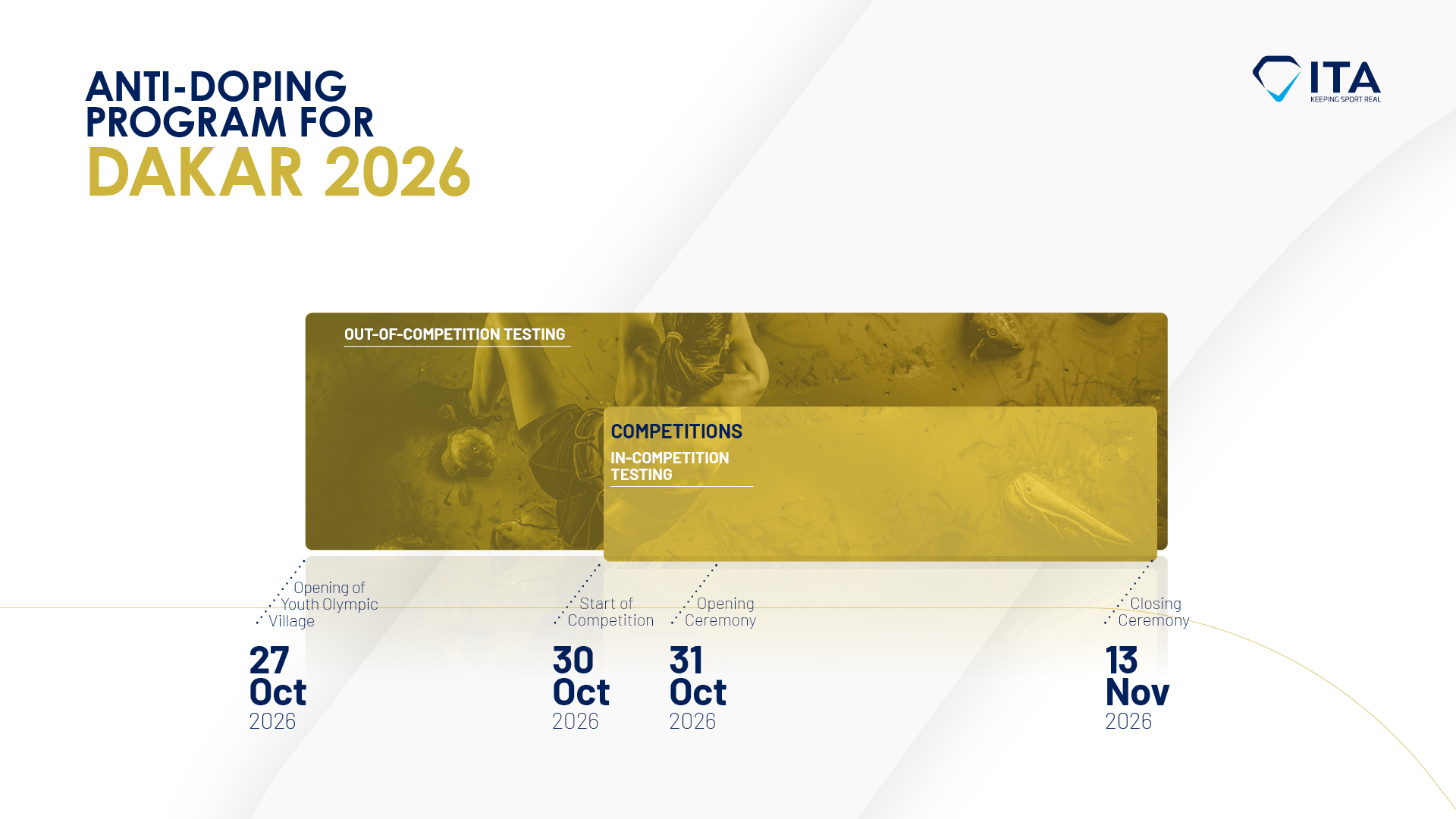
In-Competition testing can either be target testing and/or random testing. Random testing is when an athlete is selected for testing based on certain pre-decided criteria such as a competitive result, podium finish, and/or any other criteria that the ADO may determine, as opposed to a specific individual being targeted for testing.
There are several steps involved in testing which differ depending on the type of sample collected. For more information on the urine and blood (serum) testing processes, we encourage athletes to download our Athlete’s Guide to Testing in their preferred language: An athlete’s guide to testing – English – International Testing Agency or see: Anti-Doping Process | World Anti Doping Agency
When an athlete who is a minor (under 18) is selected for testing, the process is similar to that for adult athletes, but specific modifications are made to ensure their safety and well-being. The key modifications to the process can be found in this Guide to Doping Control for Minor Athletes.
Athletes must check in medications and any conditions of use against the Prohibited List before use. To do so, athletes can:
The ITA and the World Anti-Doping Agency will deliver clean‑sport education and awareness for athletes and their entourage at the Summer Youth Olympic Games Dakar 2026 as part of the Athlete Education Program in the Youth Olympic Village.
Dates: 27 October – 13 November
All athletes and their entourage are invited to participate, complete a fun interactive activity, ask anti‑doping questions, and join the Together for Clean Sport team to promote sport without doping.
The ITA’s reporting platform REVEAL helps you to share anything that you might know in a safe and confidential manner. No information is too small or irrelevant – our experts behind the scenes will process anything you might want to share in a professional and responsible way. You can make a huge difference in keeping your sport and the Games clean by acting on it!
On REVEAL, you can choose the best option for you to share information with us. This includes:
IMPORTANT: Please do not hesitate to write to us in your own language! We want to help you!
To learn more about a certain topic, you can click on the titles of the following ITA tutorials.


