 Back
Back
17 March 2026
Athletes may occasionally need to use a substance or method included on the World Anti-Doping Agency (WADA)’s Prohibited List for legitimate medical reasons. To receive necessary treatment while remaining compliant with anti-doping rules, they may apply for a Therapeutic Use Exemption. The TUE process is governed by the International Standard for Therapeutic Use Exemptions, developed by WADA, and is mandatory for all signatories to the World Anti-Doping Code.
TUEs are a vital – yet often misunderstood – component of the global anti-doping system. By making aggregated data publicly accessible, the ITA aims to strengthen transparency, improve understanding, and reinforce trust in how TUEs are assessed and managed across international sport.
Toby Cunliffe-Steel, former New Zealand rower, Chair of the New Zealand Sport Integrity Commission Athlete Commission, and member of the World Anti-Doping Agency (WADA) Athlete Council, welcomed the initiative:
“TUEs are a critical part of the anti-doping system, but they’re not always well understood by athletes or the wider sporting community. When information is hard to access, it can lead to confusion or suspicion. Making anonymised data available in a clear, digestible way helps show what TUEs actually look like in practice, without compromising athletes’ privacy. Initiatives like this are so important for building trust, protecting athlete confidentiality, and supporting confidence in clean sport.”
The dashboard allows users to explore application volumes over time, their status, and their distribution across sports and substance classes, while fully protecting athletes’ medical confidentiality.
Although only around 1–3% of athletes require a TUE, the system is often debated and sometimes misunderstood. TUEs are occasionally perceived as controversial, but in reality, they follow strict international rules and are carefully assessed by the ITA’s independent International TUE Committee (iTUEC). This body brings together highly qualified physicians from around the world, ensuring that all applications are evaluated according to consistent, expert and impartial standards. Importantly, no scientific evidence shows that a TUE provides an unfair performance advantage.
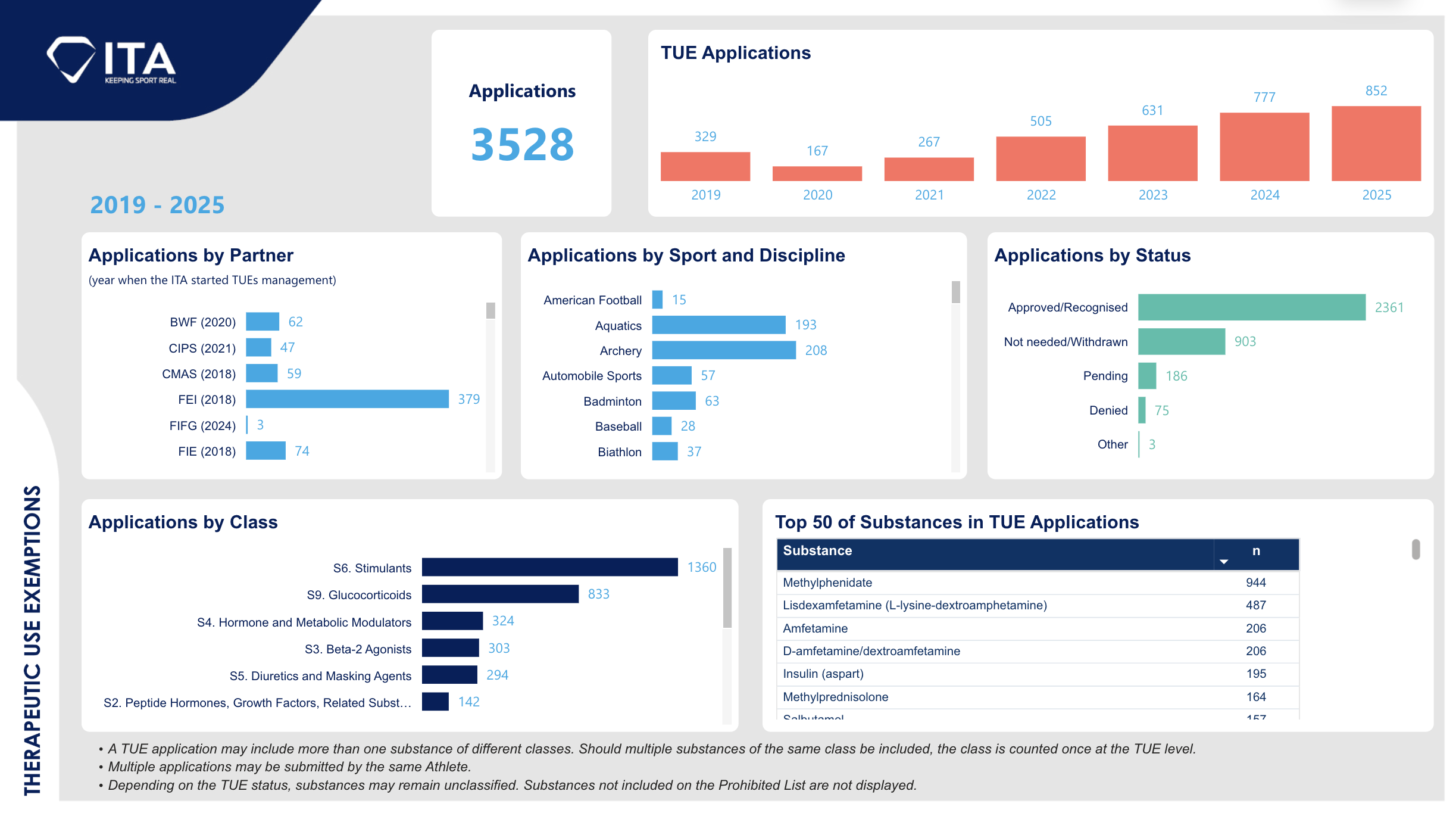
Click on the image to access the ITA TUE dashboard.
The number of TUE applications managed by the ITA has increased steadily in recent years, reflecting the growing number of International Federations entrusting their programs to the Agency as opposed to a surge of athletes taking prohibited substances to treat a medical condition. In 2023 – the first full post-COVID year – the ITA managed approximately 650 TUE applications. By 2025, this number had risen to around 850, representing an increase of approximately 25% over two .
As indicated and importantly, this growth does not indicate that more athletes require exemptions. Rather, it reflects the confidence placed in the ITA to deliver independent, expert, and confidential TUE management.
Application outcomes show a consistent pattern:
Detailed annual figures and application status breakdowns are available on the public dashboard.
The distribution of TUE applications is not uniform across sports. Variations may reflect:
For example, when sports are added to the Olympic Games program, an increase in TUE applications often follows, reflecting professionalisation and improved understanding of anti-doping requirements. It is also important to note that the ITA assumed responsibility for some International Federations’ TUE programs after 2019, which explains the absence of data for certain sports in earlier years.
TUE applications most frequently relate to commonly prescribed medications reflecting patterns observed in the general population. Typical examples include:
A small minority of applications involve:
One TUE application may include more than one substance.
The dashboard presents anonymised, aggregated data from the beginning of the ITA’s activities to the most recent full year for its International Federations partners, with annual updates planned. It enables athletes, stakeholders, and the public to better understand how TUEs are managed across sports and over time, while ensuring that athlete identities and medical information remain strictly confidential.
By combining independence, medical expertise, and transparency, the ITA’s objective is to reinforce confidence in one of the most scrutinised and essential processes in anti-doping.


