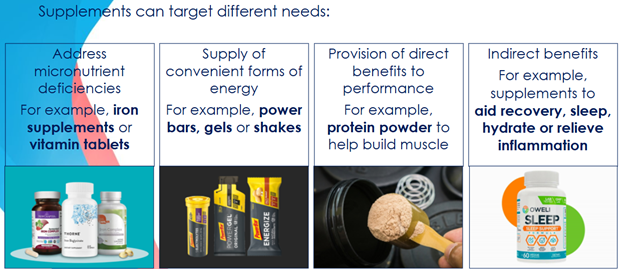
A dietary supplement is a food, food component, nutrient, or non-food compound that is purposefully ingested in addition to the diet to achieve a specific health and/or performance benefit (Maughan et al., 2018).
Athletes using supplements must be aware of the Strict Liability principle: Athletes are solely responsible for everything they use and is found in their body, regardless of whether there was an intention to cheat or not or if the athlete is at fault.
The supplement industry is not consistently regulated. This means supplements can:
These can be on the ingredients list under the same name that can be searched on the Prohibited List, or an alternative name. For example, Higenamine can be found on the Prohibited List, but this substance can also be called Nandina domestica fruit extract which cannot be found on the Prohibited List.
When compared to medications, supplements are made, stored and handled with fewer quality assurance measures and lower standards. Internationally, manufacturing practices are inconsistent. All of which means supplements can contain prohibited substances.
Supplement labels may not include all ingredients found in a product or may incorrectly state ingredient strengths. Some ingredients may also be known by different names, and not all of the names might be listed on the Prohibited List. Unreliable labels mean it is not always possible to check the stated ingredients and be 100% sure the supplement product does not contain prohibited substances.
WARNING! Labels which include wording such as “proprietary blend”, “extreme focus blend” or “testosterone boosting”, or that make claims of extreme benefits or reference to banned substances equivalent, are potential red flags and may indicate a greater risk of containing prohibited substances.
Some supplements falsely claim to be endorsed or approved by the World Anti-Doping Agency (WADA) or other anti-doping organisations. Neither WADA nor anti-doping organisations endorse or approve supplements. Additionally, some products may advertise themselves as “safe for athlete use” and make unrealistic claims about their benefits.
Alongside the risk of an Anti-Doping Rule Violation, using a product with unknown ingredients in unknown quantities is a potential health risks for athletes.
All of this means athletes should carefully weigh the benefits against the risk and make an informed decision about the use of supplements.
Remember – no supplement is 100% risk-free and use may lead to an Anti-Doping Rule Violation.
For more information on supplement risks, watch this explanation about the risks of supplements by Dr Mark Stuart (Sports Pharmacist, ITA Drugs, Health and Development Senior Manager).
While the only way for an athlete to avoid the risks of supplements is not to use them, it is acknowledged that some athletes know the risks and choose to use supplements. If an athlete is considering supplement use, to reduce the risk, they should:
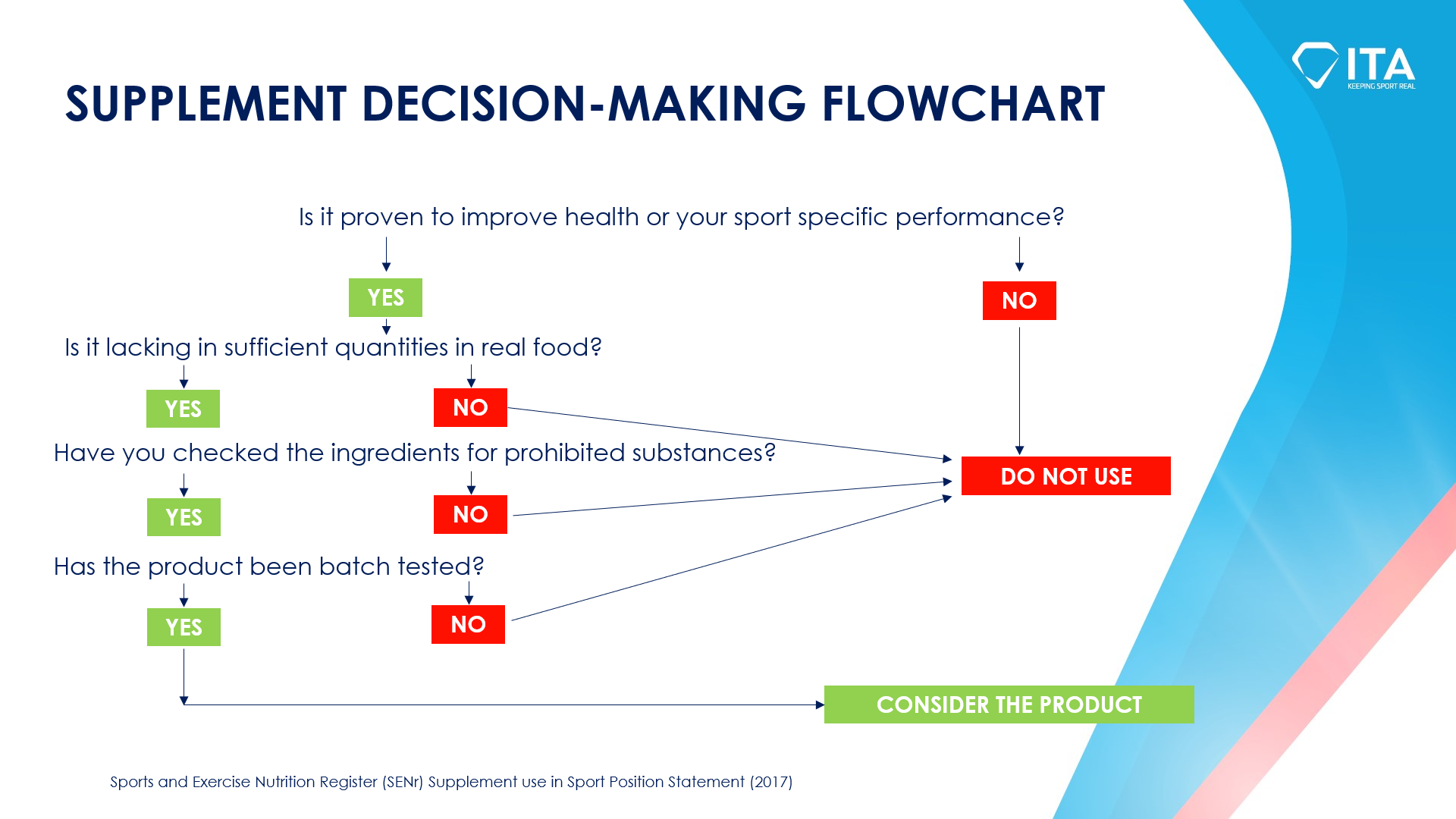
Using the information gained by considering each of the above points, athletes should ask themselves the following questions to make informed decisions about supplement use, using expert advice, support and further guidance where necessary:
For more information on supplements, athletes and support personnel are encouraged to explore this section of the ITA Athlete Hub.
The ITA has also produced a number of webinars on supplements. Click on the links below to view:
For additional support, please contact us.
3 December 2025

A dietary supplement is a food, food component, nutrient, or non-food compound that is purposefully ingested in addition to the diet to achieve a specific health and/or performance benefit (Maughan et al., 2018). Dietary supplements come in many forms, including single nutrients and multi-ingredient products which may be presented as vitamins, minerals, electrolytes, protein products, ergogenic aids, amino acids, fat burners, pre and post workout products as well as traditional, botanical and herbal remedies. Supplements are commonly ingested in the form of a tablet, capsule, powder, gummy, liquid, plant extract or oral gel.
The supplement industry is not well regulated. This means that supplements can contain prohibited ingredients which can be found on the label, be contaminated with prohibited substances, mislabelled and make false claims. This puts athlete at risk of ingesting prohibited substances which would lead to an Anti-Doping Rule Violation. No supplement is 100% risk-free.
To reduce the risk of supplements, athletes should:
Please be aware, that no supplement is 100% risk free and use may lead to an Anti-Doping Rule Violation.
Yes. The caution provided to athletes about the risks of supplement use applies to substances that may be used in TCM as, for example, athletes have returned positive test results for the presence of Higenamine which is extracted from the plant Lotus Plumule used in TCM (Kong et al., 2021). Athletes should carefully consider their use of these natural products to mitigate potential risks of inadvertent doping.
Athletes are reminded that they are solely responsible for everything they use and is found in their body, regardless of whether there was an intention to cheat or not or if the athlete is at fault.
Yes, herbal supplements are a risk for athletes for the same reasons as other supplements. If an athlete is considering using an herbal supplement they should follow the steps outlined in the above article to reduce the risk of ingesting prohibited substances.
Yes, ordering a shot of protein powder in your smoothie is a risk. Protein powder can be contaminated with prohibited substances, and in this situation, you cannot be sure on the quality of the product, whether it has been batch-tested nor have access to the information you would need to conduct thorough research.
Not necessarily, supplements sold at a pharmacy are not always safer than those purchased elsewhere, although supplements manufactured by major pharmaceutical companies are likely to be less risky as they may be manufactured under more regulated conditions than others, and some of these are available from pharmacies. However, no matter where a supplement is sold an athlete must still take the recommended steps to reduce the risk of ingesting a prohibited substance.
Stop taking the supplement immediately and retain evidence of the product in case it is required. If tested, comply with all doping control processes and requirements. This includes declaring all substances (supplements, medications) used in the seven days prior to sample collection. Athletes should also cooperate with authorities should the situation be investigated.
No. If an ingredient isn’t listed on the supplement label, it does not guarantee that it is not in the product. Inaccurate labelling is one risk of supplement use for an athlete. There have been cases where substances are not listed but have been found in the product (and an athlete’s sample).
GlobalDRO does not contain any information related to supplements. Due to inconsistent manufacturing processes and unreliable labelling practices, a guarantee of their status is not possible.
We encourage anyone with information about, or suspicions of, doping to proactively report this to the ITA using the secure REVEAL platform. More information about reporting doping can be found here.
Yes, in the event of a positive test, the athlete will face the consequences. An athlete is solely responsible for everything they use and is found in their body, regardless of whether there was an intention to cheat or not or if the athlete is at fault.
To understand what the manufacturer claims to be in the supplement, you will need to seek expert advice to translate the label. Keep in mind the risks for all supplements regarding potential contamination or mislabelling.
Batch-testing refers to the quality assurance measures taken by a third-party to check selected aspects of supplement manufacture, storage, processing and distribution (for example). In anti-doping, third-party batch-tested products are checked for the presence of prohibited substances. Evidence of batch-testing, and the results of such, should be available to athletes for decision making and record keeping purposes.
While batch-testing can reduce the risks of supplement use for athletes, and is often the most reliable way to do so, it does not provide an absolute guarantee that the product is completely free of prohibited substances – be sure to understand the limitations of batch-testing (as stated by reputable batch-testing organisations).
Third-party, batch-testing companies include (but are not limited to): Informed Sport, Certified for Sport® (nsfsport.com), HASTA, Kölner Liste or BSCG. Athletes are advised to ask their National Anti-Doping Organisation (NADO) for any country-specific recommendations.
No. Just because a supplement brand is involved in sponsorship deals with professional athletes does not guarantee that their products are batch-tested. It’s important to verify whether the brand conducts third-party batch testing and on which of their products.
Yes, you can still be sanctioned if you test positive for a prohibited substance even if you have batch-testing records. While batch-testing can reduce the risk of a positive test, it does not guarantee that a product is free from prohibited substances.
Strict Liability mean that an athlete is solely responsible for everything they use and is found in their body, regardless of whether there was an intention to cheat or not or if the athlete is at fault.
No. Some supplement companies will select only some of their products to batch-test therefore not all products they make (or supply) will have been through a third-party batch-testing process. Athletes should remain vigilant of this and, if they have chosen to use a supplement, only use one with valid third-party batch-testing records.
No, you cannot be confident that you won’t test positive for a prohibited substance, even if others using the same supplement have not tested positive. Previous testing of some supplement products has shown that different batches can contain different ingredients and different quantities of ingredients. A lack of other positive tests is not a reliable indicator of supplement risk.
Not necessarily. Each case would be heard on its own merits based on the evidence presented. Athletes should remember the principle of Strict Liability which states they are solely responsible for everything they use and is found in their body, regardless of whether there was an intention to cheat or not or if the athlete is at fault.
If a supplement used by your entire team leads to a positive test for one individual, this individual would face the consequences as they are responsible for everything they use and that is found in their body, regardless of whether there was an intention to cheat or not or if the athlete is at fault.
It is possible that a wider investigation would follow to decide whether additional Anti-Doping Rules have been broken e.g., ADRV 2.2 Use or Attempted Use of a Prohibited Substance which can be determined if there is proof of doping without a positive test.
While only the individual who tested positive would face a definite sanction, the incident would negatively affect a team’s reputation.
No athlete should be made to take a supplement without their informed consent, regardless of if the company is a sponsor. A positive test result would result in an Anti-Doping Rule Violation for the athlete and could initiate an investigation into the team’s use of a prohibited substance. Athletes are reminded that they are solely responsible for everything they use and is found in their body, regardless of whether there was an intention to cheat or not or if the athlete is at fault.
You would face the consequences in the event of a positive test as you are responsible for everything you use and that is found in your body, regardless of whether there was an intention to cheat or not or if you are at fault.
Following a positive test, a wider investigation may also follow into the athlete’s support team and their role in the situation. If the athlete is a minor and tests positive, then it is a requirement for an anti-doping organisation to investigate the athlete support personnel.


